Game Review: The Drifter
This review contains spoilers. If you are interested in the game, I recommend picking it up on Steam and playing it first.
The Drifter caught my attention one afternoon while I was scrolling through my Steam discovery queue. Having recently played through Blue Prince, Dredge, Animal Well, and The Outer Wilds, I suspect Steam was indexing on the slew of mystery/puzzle titles I’d been spending my time with lately. The trailer did a great job of hooking me in. It introduced a dramatic, gritty world scored by a moody synth soundtrack that wouldn’t be out of place in a John Carpenter movie. The backdrop visuals and character animation were on par with the best LucasArts had to offer, and it had full voice acting for dialogue (“talkie” for you old-schoolers like me). That alone was a big draw, as I’d been reminiscing about Indiana Jones and the Fate of Atlantis after playing the recent Indiana Jones and the Great Circle on Game Pass. I bought it and let it sit in my library for a couple of days until I had time to play it.
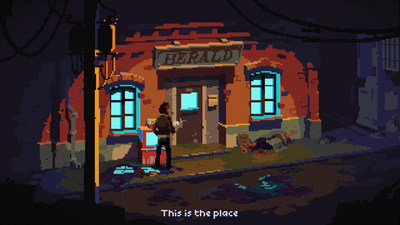
Back in the ’90s, I played a lot of the LucasArts/Sierra-style point-and-click adventures on the Amiga (such as Beneath a Steel Sky, Simon the Sorcerer and Monkey Island). Thinking back to those days, I recall the repetitious swapping of floppy disks as the player character moved between screens, presumably to account for the low memory (~2MB) and the lack of a hard drive. There are two things about the genre that are notoriously grating for people, and the disk-switching used to exacerbate them.
The first is backtracking: requiring the player to head back to a place already visited now that they have new information or a new item. The Drifter has one section (Chapter 4) that involves a bit of this but handles it well through a modernised control scheme. You can double-click on exits to immediately leave the scene rather than wait for your character to walk to the edge, and you have an in-world map that you use to fast travel. The second irritation is obtuse puzzles (shout out to the infamous cat hair moustache puzzle in Gabriel Knight 3). The Drifter has no puzzles like this, in my opinion. All the puzzles are fairly logical, and there are no missable items.
My main criticism of the game stems from this second point. It’s almost too straightforward. Games that allow you to combine inventory items tend to suffer from balancing issues. At one end of the spectrum, there are puzzles so trivial that they aren’t really puzzles at all, just busywork: “add silencer to pistol”, “give bone to dog”, or “put key in lock”. At the other end of the spectrum are outrageously obtuse puzzles that are illogical, requiring the player to perform exhaustive combinatorial testing of every object they have in their inventory, or look up the solution in a guide. The Drifter trends towards the “trivial” end. Veterans of point-and-click games are unlikely to find the puzzles much of a challenge, but I’m not sure that’s a problem: it keeps the story moving at a clip, and that pace is a big part of what makes it so exciting. I still got those “eureka!” moments, but I never struggled with a puzzle. In the vast majority of cases, the objects you encounter in the world end up being used in the same area where you found them, which reduces the need to backtrack.
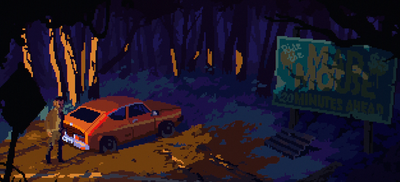
The story is unmistakably pulp - larger than life, but somehow not beyond possibility in today’s uncertain times. Mick Carter has spent the last five years drifting, having walked out on his wife Sarah while their son Alec lay dying in hospital. He’s barely back in town for his mother’s funeral before he’s attacked, knocked out, and dumped in a reservoir with a weight tied to his feet - only to find himself alive again, seconds before he drowned. That ability to rewind time at the moment of death puts him at the centre of a conspiracy run by Trinity Biotech, a medical company whose experiments are leaving the town’s homeless population either missing or insane. Underneath all the pulp, though, it’s really a story about a man finally facing up to the grief he ran away from.
This is where the twists come in. Mick, it turns out, had volunteered for the experiments of Trinity co-founder Gideon Roth, hoping to travel back and stop Alec from ever being born, sparing himself from watching his son die. Roth, meanwhile, wants to go back and kill his co-founder, Maxwell Holden, before Holden can meet (and have an affair with) Roth’s wife, Sophia. Both men see rewriting the past as the only escape from something they can’t bear - Mick’s drifting was just a lesser version of the same impulse. Mick, though, ultimately chooses to live with his grief, tricking Roth into stripping them both of the ability to rewind. After a game spent literally undoing his own deaths, Mick’s redemption comes from refusing one last do-over. This time, when Sarah ends up in a hospital bed, he stays.
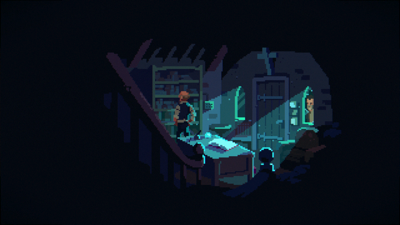
The presentation is fantastic, and, as I mentioned, it was the initial draw for me. The arrangement of the environments and the semi-isometric view remind me of a gritty Sam & Max, while the intentionally dark, minimal colour palette gives it a noir detective feel. I get a present-day or near-future vibe from the world, and find it impossible not to draw parallels between the antagonist, holed up in his desert bunker, and the tech CEOs we hear about in the news cycle. The voice acting is superb throughout (who doesn’t love an Australian accent?).
I’d forgotten the thrill of peeling back the layers of an adventure game. The Drifter gave me that feeling in spades. I binged it in a little under three days (around 12 hours of playtime) and couldn’t put it down - the gaming equivalent of a page-turner. Given my recent obsession with “metroidbrainias” and information games, this was a cosy segue. If you grew up on LucasArts, I highly recommend it.